Two — The Encounter with the Other
One says: I am.
Two answers: So am I.
With One, there was only the centre.
A point. A beginning. A self.
But the moment Two appears, something changes. There is now something outside us.
Another person. Another idea. Another possibility. Another way of seeing.
And with that, relationship begins.
Two is the first encounter with difference.
Where Two shows up in your life
We meet Two constantly.
It appears when someone disagrees with us.
When another person wants something different from what we want.
When we are attracted to someone, but uncertain what that attraction might ask of us.
When we realise that another person remembers the same conversation very differently.
When we have to choose between two possibilities.
When we discover that what feels completely obvious to us is not obvious at all to someone else.
Two is the moment we begin to understand that our perspective is not the only perspective. This can be comforting. It can also be deeply inconvenient. Because once another point of view exists, we are no longer dealing only with ourselves.
The meeting of two circles
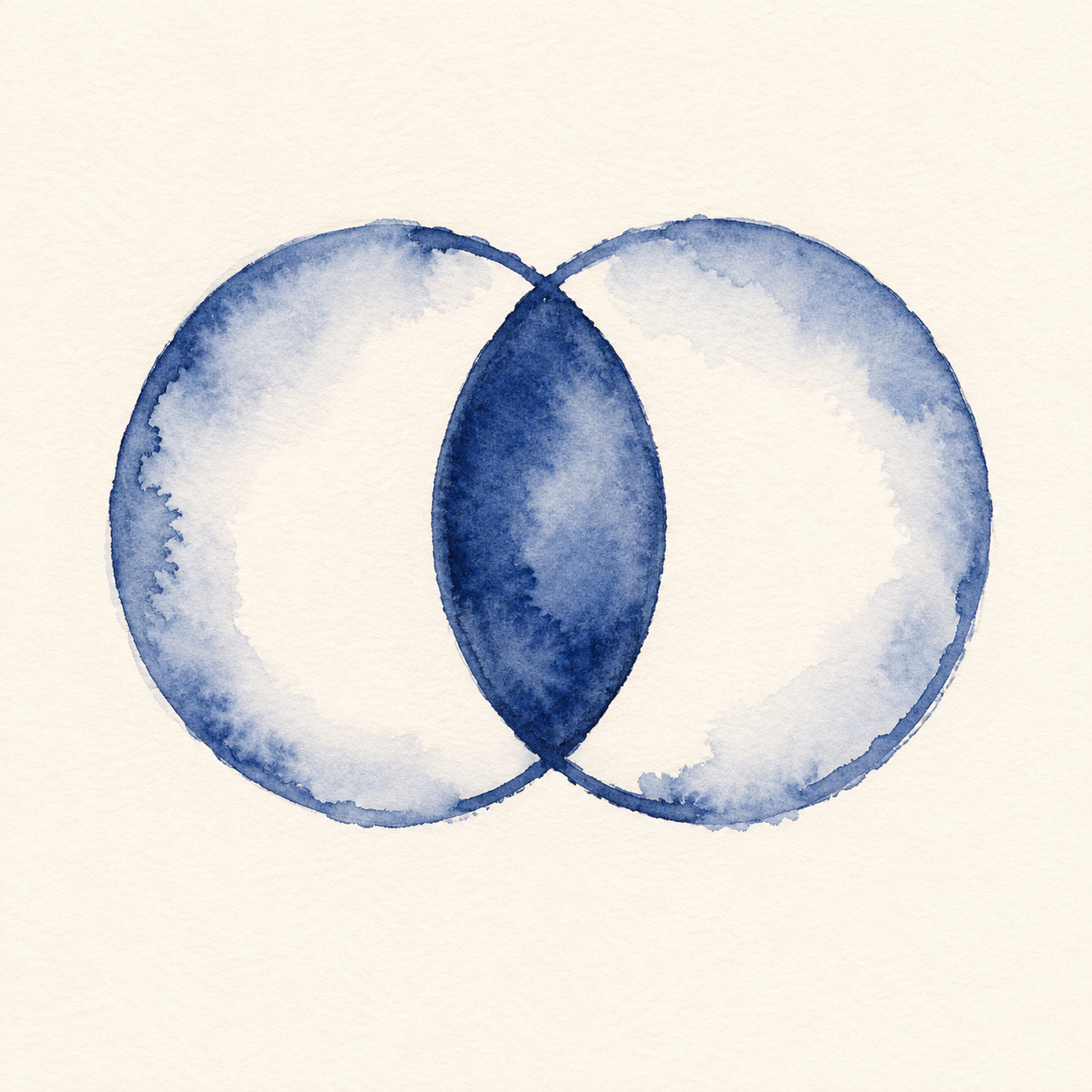
A beautiful symbol for Two is the Vesica Piscis.
It is created when two circles overlap.
Each circle remains whole in itself, but where they meet, a new space appears.That shared space is what makes the symbol so interesting.
It can represent relationship itself - the field created when two people, two ideas, two perspectives or two possibilities meet.
Neither circle has to disappear for the meeting to occur. But neither remains entirely untouched by it.
We know this from our own relationships.
There is me.
There is you.
And then there is the thing that exists between us.
A friendship has its own character.
A marriage develops its own history.
A family creates its own patterns.
Even a conversation can become something neither person could have produced alone.
The overlap is where exchange happens. It is where we influence and are influenced.
It is where we misunderstand one another, understand one another, compromise, resist, recognise and sometimes change.
Two asks whether we can remain whole while allowing ourselves to be changed by encounter.
Difference does not mean opposition
We often treat difference as though it must lead to conflict.
If you are right, perhaps I must be wrong.
If you want one thing, perhaps I have to surrender what I want.
If your experience differs from mine, perhaps one of us must be mistaken.
But Two does not necessarily create opposition.
It creates distinction.
There is a subtle but important difference:
Another person can be different from us without being against us.
Another point of view can challenge us without destroying our own.
Sometimes the encounter with something different actually makes our own position clearer:
We discover what we believe because someone questions it.
We recognise a boundary because someone crosses it.
We discover a desire because someone awakens it.
We see an aspect of ourselves because another person reflects it back to us.
In this way, the Other becomes a kind of mirror.
The mirror
Other people reveal us to ourselves in ways solitude cannot -
Someone irritates us and suddenly we discover where our patience ends.
Someone inspires us and shows us something we secretly wish to become.
Someone disappoints us and reveals what we had expected.
Someone loves us and allows us to see qualities in ourselves we had difficulty recognising alone.
This does not mean every reaction tells us something profound about ourselves. Sometimes an irritating person is simply irritating. But relationships frequently show us things that remain invisible when we are alone.
One gave us the centre.
Two gives us reflection.
The Dyad
For the Pythagoreans, Two was the Dyad - the first movement away from the unity of the Monad.
With One, there is no difference. There is simply unity. But when Two appears, distinction becomes possible: self and other, this and that, agreement and disagreement.
This made Two a more complicated number than we might imagine. It did not simply represent partnership or harmony. The Dyad introduced division, contrast and uncertainty into a world that had previously been whole.
And yet this disruption is necessary.
Without Two there can be no comparison, no relationship and no recognition of anything beyond ourselves. The One may be complete, but it cannot encounter anything until something other than itself appears.
In this sense, Two creates both the problem and the possibility of relationship.
Two in the Tarot
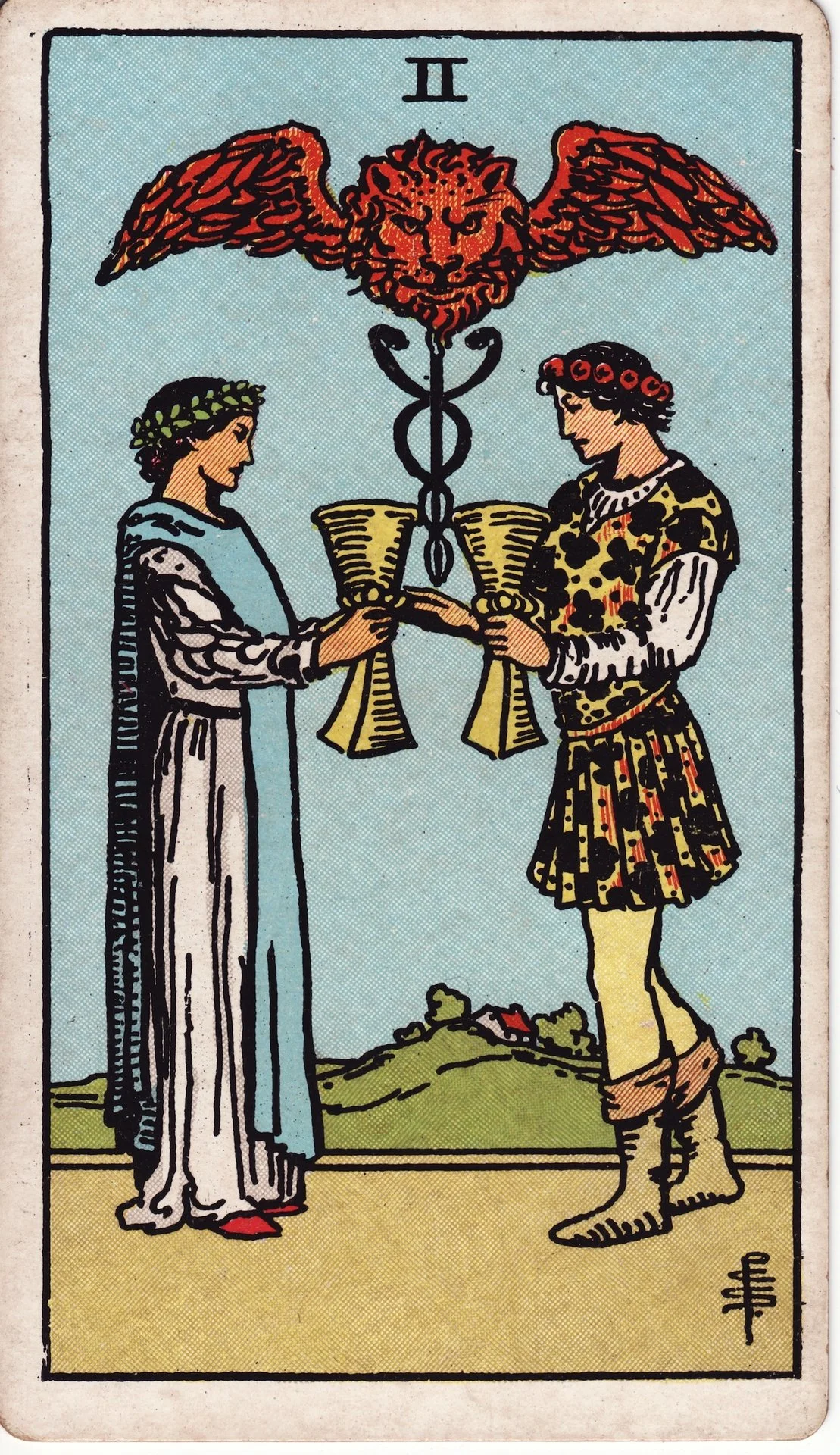
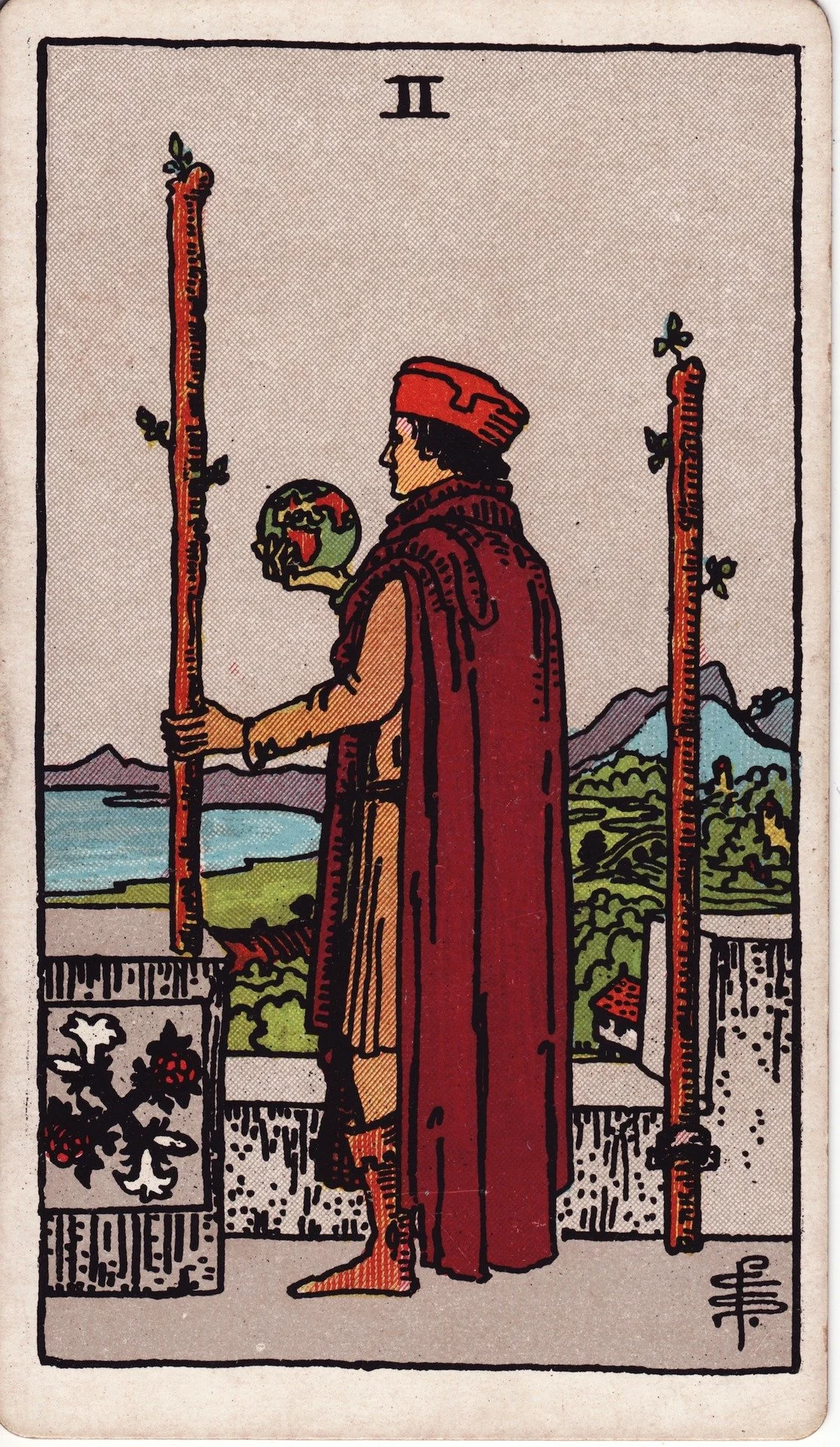
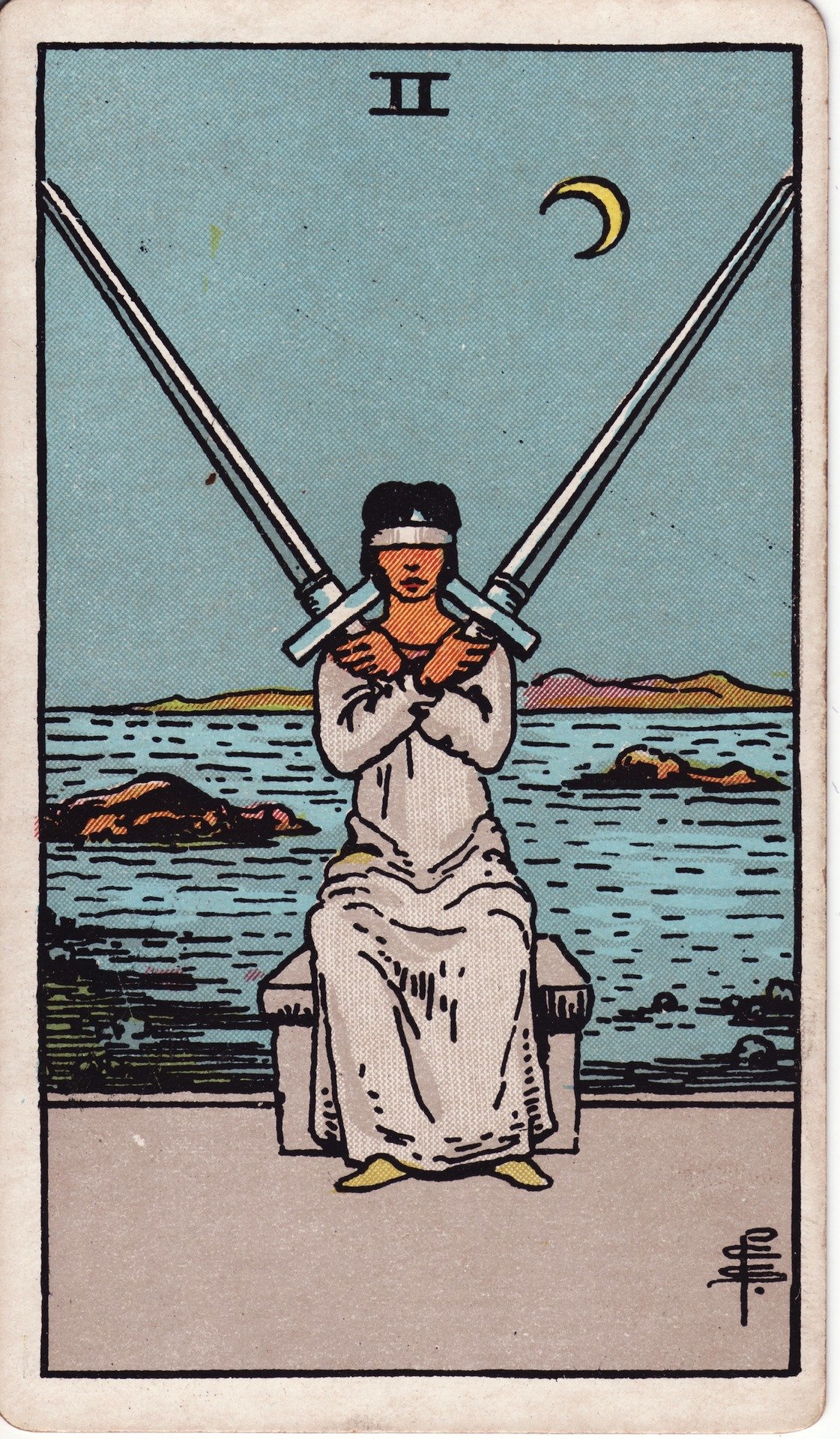
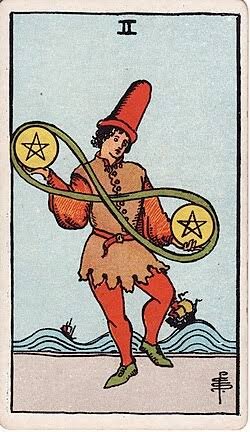
The Twos of the Tarot show just how varied this principle can be.
The Two of Cups is perhaps the most obvious expression of encounter: two people meeting, recognising and responding to one another. It speaks of reciprocity — the willingness for something to move both ways.
The Two of Swords shows another side of Two. Two possibilities are held in tension and neither has yet prevailed. Difference becomes indecision, or perhaps the need to sit with uncertainty before choosing.
The Two of Wands looks outward. There is what is already known and what might exist beyond it. Two creates the tension between staying and moving, possession and possibility.
The Two of Pentacles shows the constant negotiation that relationship with the world requires. Two demands adjustment. We balance competing priorities, obligations and realities.
Taken together, the Twos tell us something important: Relationship does not automatically mean harmony.
Sometimes Two brings union.
Sometimes it brings choice.
Sometimes it brings tension.
Sometimes it simply asks us to hold more than one truth at the same time.
The High Priestess
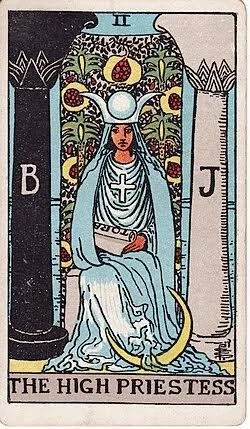
The second card of the Major Arcana is The High Priestess. She sits between two pillars - one dark, one light.
She does not destroy either one. She does not decide that one must triumph over the other. She sits between them.
This is another expression of Two: the capacity to remain present in the space between opposites.
Known and unknown.
Visible and hidden.
Conscious and unconscious.
Speech and silence.
Certainty and mystery.
The High Priestess reminds us that not every tension needs to be resolved immediately. Sometimes wisdom lies in recognising both sides before deciding what they mean.
If the Magician of One says, I can act, the High Priestess of Two asks: What might I understand if I stop long enough to listen?
The shadow of Two
Every symbol contains its tension.
The gift of Two is relationship, empathy, receptivity, cooperation and the ability to recognise another person's reality.
But the desire for connection can also become dependence and being receptive can become losing ourselves in other people.
Cooperation can become an inability to say no.
Awareness of two possibilities can become endless indecision.
And our encounters with others can become dominated by comparison:
What do they have that I don't?
Why do they think differently?
Do they approve of me?
Am I enough?
If One's shadow is isolation, Two's shadow is the loss of self in relationship.
This is why Two needs what came before it. The encounter with another does not require us to abandon the centre we discovered in One.
The two circles of the Vesica Piscis remain circles. They overlap, but neither ceases to exist.
Perhaps that is the deeper lesson of Two.
Relationship asks us to become open enough to meet another person without becoming so open that we disappear:
To listen without surrendering our own knowing.
To recognise difference without immediately turning it into opposition.
To allow another person to change us without asking them to define us.
One said: I am.
Two replies: You are too.
And somewhere in the space between those two truths, relationship begins.
A question to carry with you
Where in your life are you being asked to genuinely meet another person, idea or possibility, without either losing yourself or shutting it out?